

Celebrating 25 Years of JICAP
Key Conference Day Information
Essential details to help you plan your experience
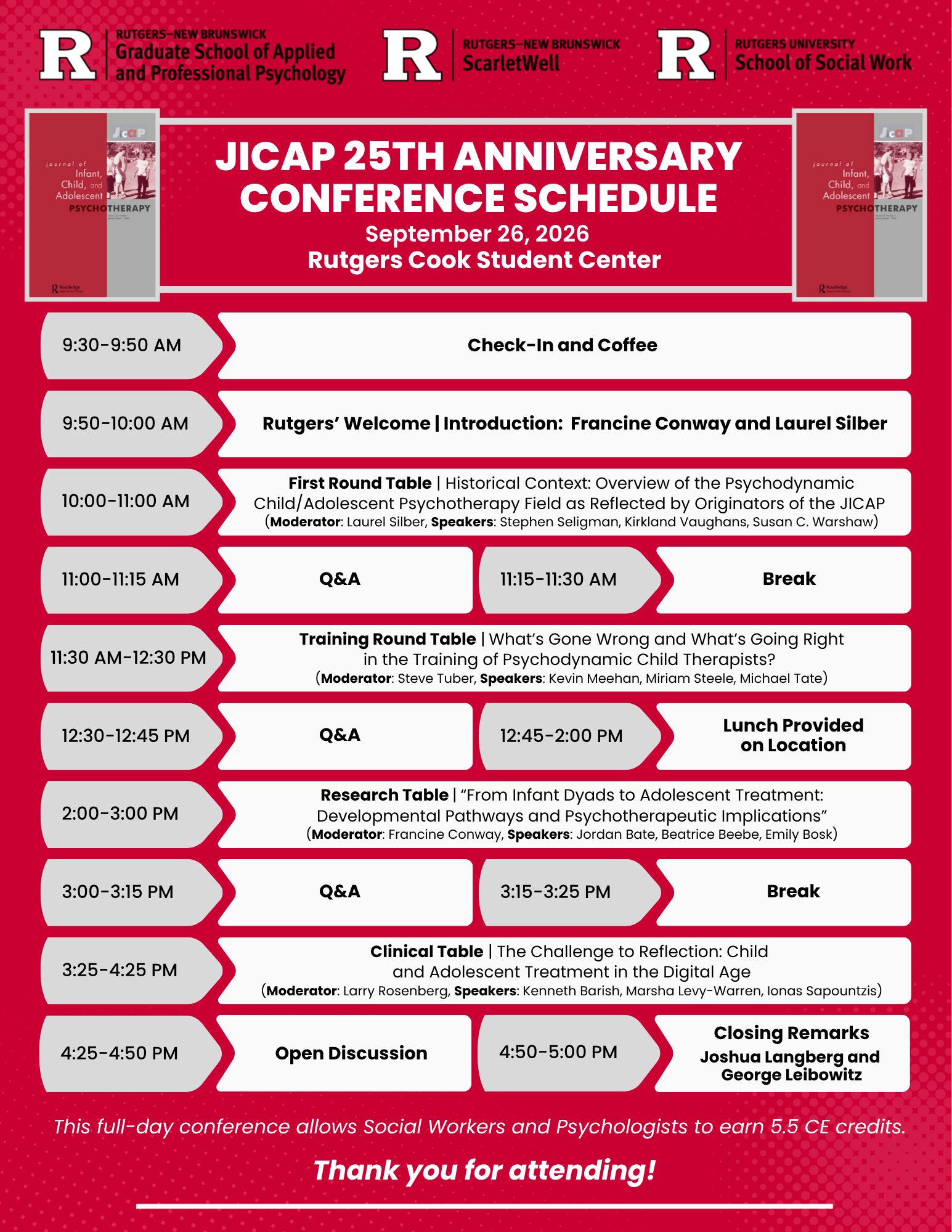
Reflections on Our Past, Present, and Future
Save the Date: September 26, 2026 — Join us at Rutgers University in New Brunswick, NJ, for the JICAP 25th Anniversary Conference, a premier gathering of clinicians, psychologists, psychoanalysts, social workers, researchers, educators, and advocates dedicated to advancing child and adolescent mental health. Celebrating 25 years of the Journal of Infant, Child, & Adolescent Psychotherapy (JICAP), this full-day conference will explore the latest developments in psychodynamic psychotherapy, attachment research, infant mental health, child development, clinical training, and interdisciplinary practice. Guided by the questions—Where were we, where are we, and where do we need to go?—this milestone event will bring leading experts together to reflect on the field’s evolution, address today’s youth mental health challenges, and help shape the future of care, research, and education.
Location: Cook Student Center, 59 Biel Road, New Brunswick, NJ 08901

Why This Conference Matters
Over the past 25 years, JICAP has championed an inclusive, psychoanalytic framework—bringing together diverse perspectives on the many forces shaping children’s mental health and well-being. As the field has evolved, JICAP has expanded its reach, amplifying emerging voices and innovations across the globe.
Today, we face a critical moment:
- Rising rates of anxiety and depression among youth
- Persistent gaps in access to mental health resources
- Societal challenges shaped by childism and inequity
This conference creates space to collaboratively confront these realities—and to chart a path forward.

Conference Experience and Format
Participants will engage in four interactive roundtable discussions designed to foster cross-generational dialogue, cross-disciplinary collaboration, and an open exchange of ideas. Guided by themes of history, training, research, and clinical process, these conversations will reflect on the field’s evolution, prepare future clinicians, advance innovation, and enhance practice.
Together, we will explore new frameworks, share emerging perspectives, and generate solutions to meet today’s urgent challenges.
To ensure broad access, the conference will be offered in-person at Rutgers University, with options for virtual attendance and full recording access for all registrants. Virtual participants will be able to engage through live chat and eligible to earn Continuing Education (CE) credits for their participation.

Learning Objectives
- Analyze how early relational processes and attachment patterns shape developmental trajectories and inform psychodynamic understanding across the lifespan.
- Evaluate how core psychodynamic constructs—such as mentalization, reflective functioning, and transference—are conceptualized, operationalized, and examined in contemporary research.
- Examine the role of social and cultural contexts in shaping development, and consider their implications for psychodynamic theory and practice.
- Explore the interplay between relational, clinical, and broader social determinants—including inequality and environmental context—in influencing developmental outcomes and access to care.
- Identify emerging methodological approaches and translational strategies that will shape the future of psychodynamic research and intervention.
- Describe innovative approaches to training child and family therapists that address evolving contemporary challenges.

JICAP Originators and Leaders
-

Kirkland Vaughans, Ph.D. is a licensed clinical psychologist and a psychoanalyst with a private practice in New York City. He is a senior adjunct professor of psychology at the Derner Institute of Advanced Psychological Studies at Adelphi University, visiting faculty member and Honorary Member at the Institute for Psychoanalytic Training and Research (IPTAR), and also holds an adjunct faculty appointment in the NYU Postdoctoral Program in Psychotherapy and Psychoanalysis. He is Director of the Denver Postgraduate Program in Child and Adolescent Psychotherapy, where he serves as the Director of the Derner/Hempstead Child Clinic. Dr. Vaughans is also an active member of the Research Council of the New York City Young Men’s Initiative and the chairman of the board for The Harlem Family Institute: a Multicultural Psychoanalytic Training Institute.
Additionally, Dr. Vaughans is the founding editor of the Journal of Infant, Child, and Adolescent Psychotherapy. He is a retired school psychologist and the former Regional Director of the New Hope Guild Centers for Child Mental Health of Brooklyn. -

Stephen Seligman, D.M.H. is Clinical Professor at the University of California, San Francisco and the New York University Postdoctoral Program in Psychoanalysis. He was Joint Editor-in-Chief of Psychoanalytic Dialogues and is a Training and Supervising Analyst at the San Francisco Center for Psychoanalysis and Psychoanalytic Institute of Northern California.
Dr. Seligman is the author of Relationships in Development: Infancy, Intersubjectivity, Attachment (Routledge, 2018) and co-editor of the American Psychiatric Press’ Infant and Early Childhood Mental Health: Core Concepts and Clinical Practice. He was a member of the founding executive board of the Journal of Infant, Child and Adolescent Psychotherapy and has authored over 75 papers, chapters, reviews, and other publications.
Dr. Seligman’s recent work has focused on translating psychodynamic concepts to the broader arenas of work with infants, both in infant-parent psychotherapy and in work with special populations, such as abused and neglected infants and infants with developmental disabilities, as well as applying knowledge about infancy to psychoanalytic theory and practice. He practices, teaches and writes about infant intervention from the perspective of the continuing evolution of the original model of designed by Selma Fraiberg and her colleagues, in which he was directly involved for over three decades.
-

Susan C. Warshaw, Ed.D., ABPP holds a Diplomate in Psychoanalysis from the American Board of Professional Psychology, is a Fellow of the American Board and Academy of Psychoanalysis, Trustee of the Accreditation Council for Psychoanalytic Education, Inc., and an Honorary Member of the William Alanson White Psychoanalytic Society. She is a psychologist licensed in New York and Massachusetts. Since 1988, she has been a Clinical Associate Professor and Clinical Consultant (aka Supervisor) with the NYU Postdoctoral Program in Psychotherapy and Psychoanalysis and was, with Emmanuel Ghent, first co-chair of the Relational Orientation during its formative years at NYU Postdoctoral Program.
Dr. Warshaw is also currently and, since its inception, a faculty member and supervisor of the Child and Adolescent Psychotherapy Training Program at the William Alanson White Institute, where she developed and for twenty years taught a course on Attachment Research and Psychoanalysis. She has been a psychoanalytic educator and supervised psychoanalytic treatment at numerous adult and child/adolescent post graduate psychoanalytic training programs, including the Postgraduate Center for Mental Health, Derner Institute, the National Institute for the Psychotherapies, the Minnesota Institute for Contemporary Psychoanalysis, and the Mitchell Center for Relational Studies.
For more than two decades, Dr. Warshaw was also a full-time Associate Professor at Ferkauf Graduate School of Psychology, where she was a core faculty member developing the School/Clinical Child doctoral program. At Ferkauf, she developed the first courses in the nation on Relational Perspectives in Child and Adolescent Treatment, taught Relational Psychoanalytic Theory and Practice, and School Consultation, and trained generations of child and adult clinical and school psychologists. After over 25 years, she retired from Ferkauf in 2009. Professionally in leadership roles in both the New York State Psychological Association and the American Psychological Association, Dr. Warshaw served as NYSPA’s Representative to APA Council Representative three terms (1983-86; 2021-23, 2024-26).
Author of numerous articles and book chapters, Dr. Warshaw was co-editor with Neil Skolnick of the 1992 book Relational Perspectives in Psychoanalysis (Analytic Press; re-issued by Taylor and Francis Routledge in paperback and e-book editions in 2015), in which she also authored a widely-referenced chapter entitled, “Mutative Factors in Child Psychoanalysis, A Comparison of Diverse Relational Perspectives.” Dr. Warshaw integrates her knowledge of child development, and her experiences in child and adolescent psychotherapy, with her decades of adult psychoanalytic work. She has written about and lectured extensively on the rapprochement of attachment research and psychoanalysis. Dr. Warshaw is a founding board member and was Associate Editor and, from 2012 through 2024, the Editor-in-Chief of the Journal of Infant, Child and Adolescent Psychotherapy.
Additional Distinguished Speakers
-

Francine Conway, Ph.D. is a highly accomplished academic leader, serving as the Chancellor of Rutgers University–New Brunswick, a top 20 public university (U.S. News and World Report) and a member of the Big Ten Academic Alliance with more than 20 programs and schools in the nation's top 15; a $907.8 million research portfolio that transcends STEM, the humanities, and the arts; and a proud culture of diversity across its more than 40,000 students and 10,000 faculty and staff.
Dr. Conway assumed the title of Chancellor on July 1, 2023, after previously serving as Chancellor-Provost and Provost. She has an extensive educational background, having graduated from Cornell and Columbia University and earned her doctoral degree from the Gordon F. Derner Institute of Advanced Psychological Studies at Adelphi University, where she was a faculty member from 2003 until 2016. She served as the chair of its psychology program for eight years, from 2008 to 2016.
Dr. Conway is also a Distinguished Professor in the Graduate School of Applied and Professional Psychology (GSAPP), where she served as Dean from 2016 to 2020 leading her school's academic programs—including a top nationally ranked doctoral PsyD program in clinical psychology. She also led the school's nationally recognized research and service centers (Rutgers Center of Alcohol and Substance Use Studies, Douglass Developmental Disability Center, Center for Psychological Services, Center for Applied Psychology) and created and built the facilities for the Rutgers Center for Adult Autism Services.
As the leader of Rutgers–New Brunswick, Dr. Conway has been responsible for the creation and implementation of the institution’s Academic Master Plan, a comprehensive blueprint for Rutgers–New Brunswick’s future based on Four Pillars of Excellence: Scholarly Leadership, Innovative Research, Student Success, and Community Engagement. The Academic Master Plan implementation includes bold new initiatives to reimagine the student experience from enrollment to retention and graduation; establish a public health and prevention-focused approach to wellness for students, faculty, and staff; create interdisciplinary scholarly communities to focus the institution’s research, economic and service engagement to benefit the common good; and more.
As Provost, Dr. Conway embraced a commitment to building a diverse and inclusive environment for faculty, staff, and students that reflects the State of New Jersey, paying particular attention to access and equity gaps of historically underrepresented populations. During her tenure, she worked with faculty to develop a robust response to the needs of the faculty identified in the COACHE faculty satisfaction survey, establishing the Center for Faculty Success and the inaugural position of Vice Provost of Faculty Affairs dedicated to supporting faculty advancement. Dr. Conway's demonstrated commitment to faculty success is evident in signature faculty support initiatives, including support for cohorts of new faculty, Provost's Fellowships in Teaching and Faculty Advancement, as well as the Rutgers Associate Professor Project (RAPP) to support the career advancement of Associate Professors. As Provost, she represented Rutgers University in two Big Ten academic leadership programs and, more recently, has been an invited guest speaker at several Big Ten academic leadership programs.
Dr. Conway has a strong scholarly focus on two critical areas – aging and child psychopathology. Her aging research has received support from the National Institute of Health's Resource Centers for Minority Aging Research and the National Institute on Aging. She has served on the executive board for the Gerontological Society of America's Behavioral and Social Sciences Division, its Research, Education, and Practice Committee, and the American Psychological Association's Division of Clinical Geropsychology. Her editorships include the Journal of Women and Aging and the Journal of Infant, Child, and Adolescent Psychotherapy. From 2000 to 2003, while she was on the faculty at Long Island University, she served as the director of the Institute on Aging. She founded and directed the GRAN Care Research and Service Center for Grandparent Caregivers.
In the area of child psychology, she has gained national and international recognition for her work on the psychodynamic treatment of children with attention deficit hyperactivity disorder, collaborating with colleagues in Sweden, Germany, and London. Conway continues to gain national prominence in translational presentations of her psychodynamic research and clinical work with children diagnosed with ADHD through national forums, such as her TEDx talk “Cultivating Compassion for the Attention Deficit Hyperactivity Disorder Child: Shifting Our Stance from Moral Indictment to Empathy” She has presented her work on national forums, such as TEDx "Cultivating Compassion for the Attention Deficit Hyperactivity Disorder Child: Shifting Our Stance from Moral Indictment to Empathy." She has also appeared in other media presentations, including “What is ADHD? Psychology in 60 seconds" and "The ADHD Compassion Project: Dispelling The Illusion of Children With ADHD as The 'Bad' Other."
Dr. Conway has authored journal articles and book chapters on her clinical and research work with children. Her 2017 book "Cultivating Compassion: A Psychodynamic Understanding of Attention Deficit Hyperactivity Disorder” was published by Rowman & Littlefield. Dr. Conway is the founder and director of the ‘Cultivating Compassion ADHD Project’ at Rutgers University. It is a research and training clinic focused on Mentalization-Based Treatment for ADHD children and their families.
Dr. Conway is an alumna of prestigious leadership programs, including the Harvard Seminar for New Presidents (2023), HERS Institute, HERS-Clare Boothe Luce Program for Women Leaders in the STEM (2017), and APA Leadership Institute for Women in Psychology (2014). She served as the Director of Academic and Scientific Affairs for the NJ State Psychological Association and President of the National Council of Schools and Programs of Professional Psychology.
-

Kenneth Barish, Ph.D. is Clinical Professor of Psychology at Weill Cornell Medicine and Visiting Professor at Tongji Medical College in Wuhan, China. He is on the faculty of Westchester Center for the Study of Psychoanalysis and Psychotherapy and the William Alanson White Institute Child and Adolescent Psychotherapy Training Program. He is Associate Editor of the Journal of Infant, Child, and Adolescent Psychotherapy and a Fellow of the American Psychological Association.
Ken is the author of How To Be A Better Child Therapist: An Integrative Model for Therapeutic Change (W.W. Norton, 2018) and Bridging Our Political Divide: How Liberals and Conservatives Can Understand Each Other and Find Common Ground (Routledge, 2024). Bridging Our Political Divide is winner of the 2025 International Book Award for Current Events.
Ken's newest book is The Art and Science of Parenting and Grandparenting (Routledge, 2026). In addition to his teaching, writing, and clinical practice, he plays jazz trumpet.
-

Jordan Bate, Ph.D. is a clinical psychologist and Associate Professor at Adelphi University in New York, where she leads the Attachment and Psychotherapy Process research lab. She is on the voluntary faculty of Lenox Hill Hospital, Northwell Health, where she is co-investigator on a pilot study of the implementation of MBT-CYP in the outpatient clinic.
Her research also includes the study of attachment-based and mentalization-focused interventions for families involved in the child welfare system, personality development in adolescence, and training for therapists. Dr. Bate is co-author of two books: Deliberate Practice for Child and Adolescent Psychotherapy and Working with Parents: A Mentalization Based Approach (both APA Books). She also maintains a private practice in New York City.
-

Beatrice Beebe, Ph.D., is Clinical Professor of Psychology (in Psychiatry), College of Physicians & Surgeons, Columbia University Medical Center, New York State Psychiatric Institute. She is an infant researcher and a psychoanalyst, known for video microanalysis of mother-infant interaction and its implications for infant and adult treatment. Her frame-by-frame video microanalyses provide a “social microscope” that reveals subtle details of interactions too rapid to grasp in real time with the naked eye.
Her research investigates early mother-infant face-to-face communication: the effects of maternal distress (depression, anxiety, trauma of being pregnant and widowed on 9/11), the prediction of infant attachment patterns, and the long-term continuity of communication from infancy to adulthood. More than 150 students have been trained in her research laboratory over the last three decades. Her recent book is: The mother-infant interaction picture book: Origins of attachment (Beebe, Cohen & Lachman, Norton, 2016). Dr. Beebe has a YouTube account: http://youtube.com/@dr.beatricebeebe8658
Her new research direction, with Julie Herbstman, is the association of prenatal environmental toxins with four-month mother-infant interaction. She is Multi-PI, with Julie Herbstman, R01ES027424-01A1, of Prenatal endocrine-disrupting chemicals and social/cognitive risk in mothers and infants: Potential biologic pathways.
-

Emily Adlin Bosk is an Associate Professor of Social Work and a Faculty Affiliate with the Institute for Health, Health Policy, and Aging Research, the Center for Research on Ending Violence, and the Department of Sociology. Trained as both a sociologist and a clinical social worker, Dr. Bosk works at the intersection of social theory and applied practice. Her research examines how organizations, practitioners, and policymakers understand and intervene with children and families and the policy and practice implications of their different approaches. The goal of her work is to develop policies and interventions that help families and children thrive.
Dr. Bosk’s clinical specialty is in the early years and complex trauma. Currently, she is developing two clinical interventions: One to treat complex trauma in caregivers with substance use disorders and the second to promote parental sensitivity and attunement with young children through drumming.
Committed to translating her research work for policymakers and practitioners, Dr. Bosk regularly collaborates with the state of New Jersey and community-based mental health organizations on policies and interventions to prevent maltreatment and promote child and family wellbeing. At the School of Social Work, she leads the Substance Use, Trauma, Attachment, and Resilience Initiative (S.TA.R.) which is dedicated to advancing research and interventions to address the intersection of substance use, parenting, and childhood trauma.
Dr. Bosk has held fellowships in The Prevention of Child Maltreatment and the Promotion of Child Wellbeing through the Doris Duke Foundation and in Clinical Social Work in the Intensive In-Home Child and Adolescent Psychiatric Services Division at the Yale Child Study Center. Her work has been funded by grants from The National Science Foundation, the Kellogg Foundation, and the Fahs-Beck Fund for Research and Experimentation.
-

Marsha H. Levy-Warren, Ph.D. is a clinical psychologist and psychoanalyst who writes, teaches, lectures, and consults both nationally and internationally. She is the author of The Adolescent Journey (Jason Aronson, 1996; reissued by Rowman and Littlefield, 2004), and numerous articles on clinical and developmental theory, adolescence, and various aspects of culture.
She is an Adjunct Clinical Associate Professor of Psychology and a Clinical Consultant in New York University's Postdoctoral Program in Psychotherapy and Psychoanalysis, and faculty and a Training and Supervising Psychoanalyst at The Contemporary Freudian Society. Dr. Levy-Warren has a clinical practice with adolescents and adults, and a consulting practice with parents on the Upper West Side of Manhattan.
-

Kevin B. Meehan, Ph.D. is a Professor in the Department of Psychology, and Program Director of the Ph.D. Program in Clinical Psychology at Long Island University (LIU, Brooklyn Campus). Dr. Meehan is a Fellow of the American Psychological Association (Div 29 & 39), and Adjunct Clinical Assistant Professor of Psychology in the Department of Psychiatry at Weill Cornell Medical College, where he collaborates with colleagues at the Personality Disorders Institute in evaluating a treatment for borderline personality disorder called Transference Focused Psychotherapy.
At LIU, he directs the Social Cognition & Personality (SCOPE) Lab, which evaluates self and interpersonal functioning, emotion dysregulation, and suicidal ideation in both college-age and personality disordered populations. He is an investigator on a number of NIMH-funded studies evaluating proximal indicators of suicide. He maintains a psychotherapy practice for adults and children in Brooklyn.
-

Larry M. Rosenberg, Ph.D. is a prominent clinical psychologist, author, and psychoanalyst based in Stamford, Connecticut, who specializes in psychotherapy for children, adolescents, and adults. With nearly four decades of experience in private practice, he is highly regarded for his work in clinical training, community mental health, and psychodiagnostic systems like the Psychodynamic Diagnostic Manual (PDM-2)
-

Ionas Sapountzis, Ph.D., is a Professor at the Derner School of Psychology of Adelphi University and the Director of the School Psychology programs. He is a faculty member and supervisor in the Psychoanalytic Psychotherapy and in the Child, Adolescent and Family Psychotherapy Programs of the Derner School of Psychology.
His articles have been published in the journals of Psychoanalytic Psychology, Psychoanalytic Review, Psychoanalytic Perspectives, Psychoanalysis Culture and Society, and in the Journal of Infant, Child and Adolescent Psychotherapy (JICAP). Dr. Sapountzis works with children and adolescents with emotional and learning disabilities and also with children and adolescents on the spectrum. He maintains a private practice in Garden City, New York.
-

Laurel M. Silber, Psy.D. has a clinical practice working with children, adolescents and their families in Bryn Mawr, PA. She serves on the Editorial Board of the Journal of Infant, Child, and Adolescent Psychotherapy. She is a past President of the Section on Children and Adolescents of Division 39.
Dr. Silber has presented and published articles on subjects such as the therapeutic action of play, childism, intergenerational transmission of trauma, and gender. Her book, Transforming Transmitted Trauma with a Child in Mind, is in press. She is the former Director of the Child Relational Psychotherapy Program of the Institute of Relational Psychoanalysis of Philadelphia.
-

Miriam Steele, Ph.D. is Professor of Psychology and Co-Director of the Center for Attachment Research at The New School for Social Research. She trained as a psychoanalyst at the Anna Freud Centre. Her work aims to bridge the world of psychoanalytic thinking and clinical practice with contemporary research in child development. She initiated the London Parent–Child Project, a major longitudinal study of intergenerational patterns of attachment that gave rise to the concept of "reflective functioning."
Dr. Steele has published more than 100 journal articles and book chapters, many in collaboration with Howard Steele. With Howard Steele and Anne Murphy, Dr. Steele has pioneered the development of Group Attachment-Based Intervention (GABI©), aimed at preventing child maltreatment and promoting attachment security. She is a recipient of the 2017 Bowlby–Ainsworth Award from the Center for Mental Health Promotion, which cited her innovative longitudinal studies and translational research on attachment and mental representation.
-

Dr. Michael Tate, Ph.D. is a clinical psychologist, musician, and educator. He is an Assistant Professor of Clinical Psychology at Ferkauf Graduate School of Psychology in the child school/clinical PsyD program. He is also a staff psychologist at The Manhattan School of Music, an active music teacher and composer, and the founder of CrescendoNY - an organization that aims to deliver high-quality equitable music education to all students.
Dr. Tate completed his clinical training at The City College of New York (CCNY) in the Clinical Psychology PhD Program. During his tenure at CCNY, he received a diverse array of clinical training experiences-- including being a therapist in residence at The Psychological Center in Harlem/Washington Heights, Manhattan School of Music, and Queens College Health and Wellness Center, and completing his Internship at Lenox Hill Hospital. Additionally, Dr. Tate has received training in asylum work during his residency at The Psychological Center. Dr. Tate’s therapeutic orientation is best described as integrative with a strong psychodynamic foundation. He has worked with adults, adolescents, and children, with particular interest in childhood, emerging adulthood, and musician/artist populations. He incorporates elements of visualization, creativity, insight, ethnic/cultural awareness, and interpersonal processing into his clinical practice.
Dr. Tate also is the founder of the Child Adolescent Neurodevelopment and Environmental Enrichment Lab (CANDEE Lab). The CANDEE Lab explores the interconnectedness of child neurodevelopment, emotions, identity formation, and the environment. The lab aims to provide research and tangible initiatives that ultimately encourages holistic growth of the child and offset the deleterious impact of social and economic disparity. Currently, we are continuing the exploration of the impact of music training on child/adolescent emotion and neurodevelopment.
Prior to his career in psychology, Dr. Tate completed his Bachelor of Music in Music Education and Bachelor of Arts in Psychology at Ithaca College and a Master of Arts in Psychology at Long Island University Brooklyn. He worked for several years in the New York public/charter school system, as a private music instructor, and co-developed and taught the Psychology of Music course at CCNY.
-

Steve Tuber, Ph.D. is the former Director of Clinical Training, Program Head, and Professor of Psychology in the doctoral program in Clinical Psychology at The City College of New York. He is a Diplomate in Clinical Psychology of the American Board of Professional Psychology, a Fellow of the American Academy of Clinical Psychology, and a licensed psychologist in New York State.
Dr. Tuber also serves on the teaching faculty of the child psychotherapy program at the William Alanson White Institute in New York. He earned his doctoral degree in Clinical Psychology from the University of Michigan and has held positions as an Attending Psychologist at both Montefiore Medical Center and Roosevelt Hospital in New York City.
He is the recipient of City College’s President’s Award for Excellence, the institution’s highest faculty honor, recognizing his outstanding contributions to teaching, scholarship, and service.
Sponsors and Partners
We gratefully acknowledge the generous support of our sponsors and partners, whose collaboration makes this conference possible.

|

|

|

|
Continuing Education Information
This conference allows Social Workers and Psychologists to earn 5.5 CE credits.
Rutgers Graduate School of Applied and Professional Psychology (GSAPP) is recognized by the New York State Education Department's State Board for Psychology as an approved provider of continuing education for licensed psychologists #PSY-0123.
LMFT/MFT and LPC/LAC Licensed in New Jersey: Programs approved by the American Psychological Association are acceptable sources of continuing education credits. Please see https://www.njconsumeraffairs.gov/regulations/Chapter-34-Subchapters-10-31-Professional-Counselors.pdf, Section: 13:34-15.4 APPROVAL OF COURSES OR PROGRAMS on page 27. For all other professional licenses and certifications, please reference your issuing state board regulations regarding reciprocity of continuing education credits.

Rutgers Graduate School of Applied and Professional Psychology is approved by the American Psychological Association to sponsor continuing education for psychologists. Rutgers Graduate School of Applied and Professional Psychology maintains responsibility for this program and its content.
This program is approved for social work continuing education hours by the Rutgers School of Social Work, 390 George St., New Brunswick, NJ (848-932-8758) in accordance with New Jersey Administrative Code 13:44G and recognized by, the New Jersey Board of Social Work Examiners, the New Jersey Alcohol & Drug Counselor Committee, the Pennsylvania State Board of Social Workers, Marriage & Family Therapists and Professional Counselors, and the New York State Education Department's State Board for Social Work as an approved provider of continuing education for NY licensed social workers #SW-0069. The Rutgers School of Social Work, Office of Continuing Education, is approved as an ACE provider (#1849) to offer social work continuing education by the Association of Social Work Boards Approved Continuing Education program. ACE provider approval period: 4/5/2024 - 4/5/2027.