
Academic Programs in Applied Behavior Analysis
GSAPP offers students multiple pathways to academic training in applied behavior analysis (ABA).
Don't Miss Our Free Virtual Open House
Overview
Multiple pathways. One purpose: preparing you through immersive coursework and hands-on ABA practice.
For those:
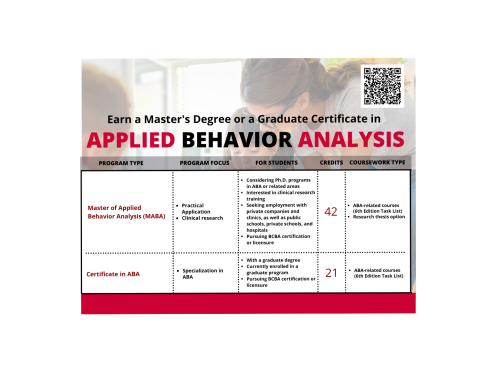
- Seeking a master's degree, consider our Master of Applied Behavior Analysis (MABA) program.
- Who already have a relevant graduate degree or are pursuing a graduate degree in another program, consider our Graduate Certificate in ABA.
- Interested in seeking training in special education with specialization in ABA, consider the Master’s Degree Program in Special Education with the ABA sequence.
All programs are designed to train students to become exceptional behavior analysts who provide the highest quality of care using state-of-the-art, evidence-based practices and are integral components of Rutgers GSAPP's Autism Training Hub.
Master of Applied Behavior Analysis (MABA)
The Master of Applied Behavior Analysis (MABA) Program in GSAPP's Applied Psychology Department trains students to become highly-skilled behavior analysts who apply evidenced-based behavioral interventions to address the behavioral challenges of individuals in need. Our program is perfectly aligned with Rutgers University’s and GSAPP’s mission to train professionals who can integrate scientific knowledge with innovation in the delivery of clinical care that helps individuals and the local, national, and global communities where they live.
Students receive expert classroom instruction complemented by essential real-world training. Graduates are well-educated, qualified, and competent behavior analysts and clinical researchers with a strong commitment to community engagement and direct service to underserved populations. They complete a 42-credit Master of ABA degree that delivers comprehensive foundational knowledge and rigorous applied training in behavior analysis.

More on MABA
The foundation is based on knowledge of the scientific basis of ABA and the values our school embraces--civic and global citizenship; social justice and helping the underserved; and cultural competency. It is our expectation that these values will become the lens through which students view human interactions and will be emphasized in their supervision groups.
The applied emphasis of the program includes opportunities for students to receive training in socially-significant areas of behavior analysis, participate in practicum, and have opportunities to integrate their didactic and applied learning experiences. This program will prepare graduates to become BCBAs who can independently practice ABA or continue to obtain their doctorate in behavior analysis.

MABA in Camden
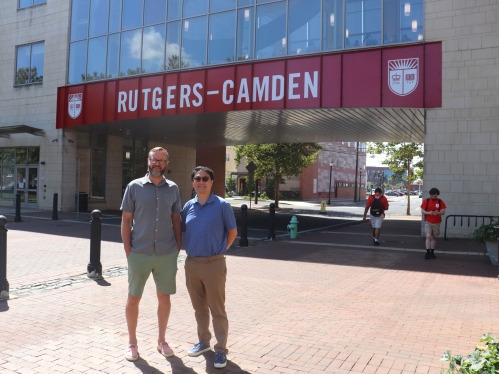
Our Master of Applied Behavior Analysis (MABA) Program is available in Rutgers-Camden! Behavior Analysts are in high demand and often receive multiple job offers within months of graduation and certification. We are excited to expand our reach by partnering with RU-Camden to offer graduate-level ABA courses and training to an even greater population of students looking to enter this in-demand field.
Certificate in ABA
Our Certificate in Applied Behavior Analysis program offers specialization in ABA and meets the academic coursework requirements for certification in behavior analysis through the Behavior Analyst Certification Board (BACB).
Individuals pursuing a BACB credential will also need a graduate degree, appropriate supervised experience, and a passing grade on the national certification exam.
The Association for Behavior Analysis International has verified our courses toward the coursework requirements for eligibility to take the Board Certified Behavior Analyst examination. Applicants will need to meet additional requirements before they can be deemed eligible to take the exam. This program is designed for individuals who are currently working towards or already have their graduate degree. Learn more about a sample course schedule.
Applications deadlines: Fall Semester, rolling admissions and Spring Semester, rolling admissions

Practical Training
GSAPP offers students the ability to gain valuable, practical, supervised, on-site training at our renowned community-based centers. These centers use an ABA model and are nationally recognized for their commitment to evidenced-based intervention. Both are located on the Rutgers-New Brunswick campus.
The Douglass Developmental Disabilities Center (DDDC) provides services to individuals with autism spectrum disorders (ASD), their families, and schools. The Rutgers Center for Adult Autism Services (RCAAS) supports adults with ASD through a wide range of services (e.g., employment, college) specifically tailored to individual preference and ability.

Industry Experts
GSAPP faculty and staff pride themselves on their involvement in professional organizations and staying abreast of industry trends. These RU-GSAPP members, experts in applied behavior analysis, currently serve on the NJABA Board of Directors. Many GSAPP faculty and staff have previously held key leadership roles as well.

Explore our Toolkit for ABA Instructors
A Quality Education
The Association for Behavior Analysis International has verified our coursework as meeting requirements for eligibility to sit for the Board Certified Behavior Analyst® (BCBA) examination. Applicants must still fulfill additional requirements to qualify for the exam.
Our curriculum is aligned with the Behavior Analyst Certification Board’s Fifth Edition Task List and is designed to provide a strong foundation in both theory and practice. Faculty prepare students for the BCBA exam through rigorous coursework paired with applied fieldwork experiences.
Students gain valuable hands-on training through placements in Rutgers-affiliated programs as well as with external partner organizations—ensuring they graduate with the knowledge, skills, and professional experience needed to succeed in the field.

Take a Course Before You Apply
Interested in the MABA program but not yet ready to commit? Rutgers GSAPP offers prospective students the chance to try a course as a non-matriculated student. Earn credits that can later be applied toward a graduate degree and experience what our programs have to offer—before you apply.
- 18:820:513 - Basic Principles of Behavior Analysis (Fall & Spring)
- 18:820:512 - Introduction to Analysis and Single Case Design (Fall & Spring)
ABA Academic Programs FAQs
-
Our courses are scheduled for 2.5 hrs, Monday-Thursday at 3:35 p.m. or 6:15 p.m. to accommodate those students who work during the day. We find that working in ABA-related organizations strengthens the graduate training experience. Work experience helps to synthesize the course content.
-
Although we encourage our graduate students to participate in ABA-related fieldwork experiences, we do not place students nor can we guarantee that you will complete all the BACB fieldwork hours by the time you graduate. Many of our students work at ABA sites at Rutgers as well as outside of Rutgers.
-
Our program is in person. Classes are typically taught on the Busch Campus.
-
Graduates of our ABA academic programs have gone on to obtain their BCBA so that they can work for private companies, public schools, private schools, and university-based programs. Additionally, our students have continued to doctoral programs.
-
Although beneficial, this does not guarantee acceptance.
-
The MABA program offers students the option to complete either a capstone or a thesis. The capstone focuses on demonstrating content mastery through curriculum review and the development of a clinical portfolio, making it ideal for students planning to pursue professional practice. In contrast, the thesis is designed for students seeking additional research experience alongside their clinical training and is particularly suited for those considering doctoral programs in Applied Behavior Analysis (ABA). The thesis involves conducting an original research project under the guidance of our faculty.
-
Click here for costs per credit and financial information. For more information, contact the financial aid department.
Please note that our programs are in the Graduate School of Applied & Professional Psychology (GSAPP) at Rutgers – New Brunswick.