

Faculty Research Labs and Projects
Evidence-Based Work
GSAPP’s faculty lead innovative research that bridges science, practice, and community impact. Their scholarship addresses relevant issues across varying domains, reflecting our strong commitment to improving lives across populations, systems, and settings. Many faculty members also direct specialized research labs and projects that provide key training opportunities for students and foster synergistic interdisciplinary collaboration. Explore their empirically informed work and its far-reaching contributions to the field of psychology.
Collaborative for Outcomes, Research, and Engagement in School Mental Health (CORE Lab)
Through several Research-Practice Partnerships with large public-school districts, the Collaborative for Outcomes, Research, and Engagement in School Mental Health (CORE Lab) aims to aid in the implementation and evaluation of trauma-informed Multi-Tiered Systems of Support (MTSS). Through funding from the Substance Abuse and Mental Health Services Administration (SAMHSA), the lab aims to increase school-based mental health services in these districts by investing in Social-Emotional Learning (SEL) programs, training school staff on trauma-informed skills, supporting families, and training clinicians to provide trauma-informed, evidence-based interventions.

Context and Identity in the Treatment of Youth (CITY) Lab
At the CITY Lab, our mission is to understand and address the factors that contribute to suicide risk among marginalized youth. We investigate how experiences such as discrimination, cultural values, and identity development affect mental health and help-seeking behaviors. By translating this knowledge into innovative, evidence-based interventions, we aim to improve treatment engagement, strengthen mental health outcomes, and promote suicide prevention.

Cross-Cultural Occupational Stress & Health Research Lab (COSHR Lab)
Led by Dr. Sharon Glazer, the COSHR Lab focuses on various research programs, such as Meaningfulness in Life (MIL), Type A Behavior Pattern, Diversity Across Cultures, Implications of Financial Stressors, and Translation Processes.

Culture & Diversity Toolkit for ABA Instructors
The grounding framework of the Toolkit is the Standards for Cultural Competence in Behavior Analysis proposed by the Multicultural Alliance of Behavior Analysis developed by Fong and Tanaka (2013). The Toolkit contains 32 Learning Objectives for ABA Courses.

Homework, Organization, and Time-Management Skills (HOPS)
The Homework, Organization, and Time-Management Skills (HOPS) intervention was developed by Joshua M. Langberg, Ph.D., a clinical psychologist, with support from the U.S. Department of Education’s Institute of Education Sciences (IES).
HOPS teaches students essential organization and time-management strategies and how to apply these skills to complete homework effectively and prepare for tests. The intervention has been evaluated in multiple randomized trials and shown to be effective for middle school students diagnosed with Attention-Deficit/Hyperactivity Disorder (ADHD).

Lab for Immigrant Rights and Mental Health
Led by Dr. Germán Cadenas: We believe that immigrants are deserving of humane policies, programs, and services that affirm their dignity.
We partner with immigrant rights advocates and organizations to conduct action research that highlights the cultural strengths of the immigrant community.
We develop, pilot, and assess interventions and strategies to support the wellbeing of immigrants across a diversity of settings and contexts: education, higher education, career/work, mental health, and health.
We support educators and mental health service providers in developing competencies to serve immigrant youth and families.
LifeSPAN Autism Lab
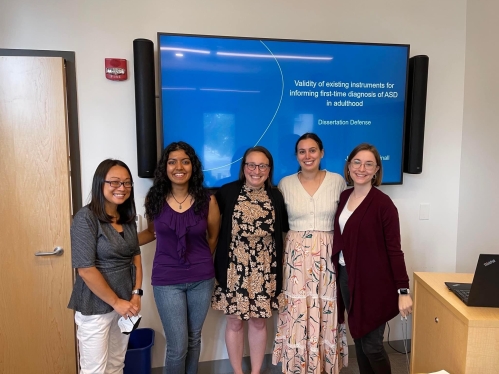
The Lifespan Symptom Profiles, Achievements & Needs in Autism (LifeSPAN Autism) Lab is led by Dr. Vanessa H. Bal.
Dr. Bal's research aims to advance understanding of autism in adulthood. By emphasizing a lifespan perspective, the lab encompasses four broad research areas:
- Defining meaningful achievements and specific needs of autistic adults;
- Characterizing how autism manifests across the range of cognitive and language abilities at varying developmental stages across the lifespan;
- Identifying behavioral, biological and contextual factors that affect longer-term adult outcomes;
- Developing and adapting approaches to support the well-being of autistic adults.
Organizational Trauma Intervention Studies (OTIS) Lab
At the OTIS Lab, led by Dr. Preston Lindsay, our mission is to advance the understanding and treatment of trauma within organizational contexts. We focus on the pervasive psychological, emotional, and social impacts of adverse events, such as sudden changes, conflicts, violent events, layoffs, and ethical breaches. Central to our work are the concepts of psycho-systemology and the theory of organizational dysregulation, which examine how interconnected systems and stressors within organizations influence behaviors and lead to systemic breakdowns.

Reducing Inequities in Student Education (RISE) Lab
The Reducing Inequities in Student Education (RISE) Lab focuses on understanding and disrupting the ways individual and systemic racial biases influence the school discipline experiences and social-emotional growth of racially minoritized students from early childhood through adolescence (PreK–12). Using diverse research approaches, we explore how these biases emerge, persist, and operate within educational settings, and how they shape developmental and academic outcomes over time.

School Climate Transformation Project (SCTP)
Led by Dr. Todd Glover, the School Climate Transformation Project (SCTP)—a partnership between the Rutgers Graduate School of Applied and Professional Psychology and the New Jersey Department of Education—supports public K–12 school districts in implementing a data-driven process to promote systems-level change and foster inclusive, positive school climates.
As part of this effort, SCTP developed the New Jersey School Climate Improvement (NJ SCI) Survey, administered through the NJ SCI Platform, an online system featuring data collection tools and strategic planning resources. These tools help school leaders use data to set climate goals, implement research-based strategies, and monitor progress over time.
Social Media
Follow Us